Next Cohort Starting Soon

AI Engineer Launchpad

From ML Foundations to Production-Ready Agentic AI — in 6 Weeks

4.9/5 Average Rating · Trusted by 25,000+ Future Engineers
Starts Sep 1, 2026
6 Weeks · 36 Live Sessions
Certification + Internship

Request a Call Back

Book a free career consultation call with an expert AI Engineer mentor.

✓ Program Consultation & Career Guidance
Industry Paradigm Shift

Why Learning Agentic AI is Crucial for Software Engineers

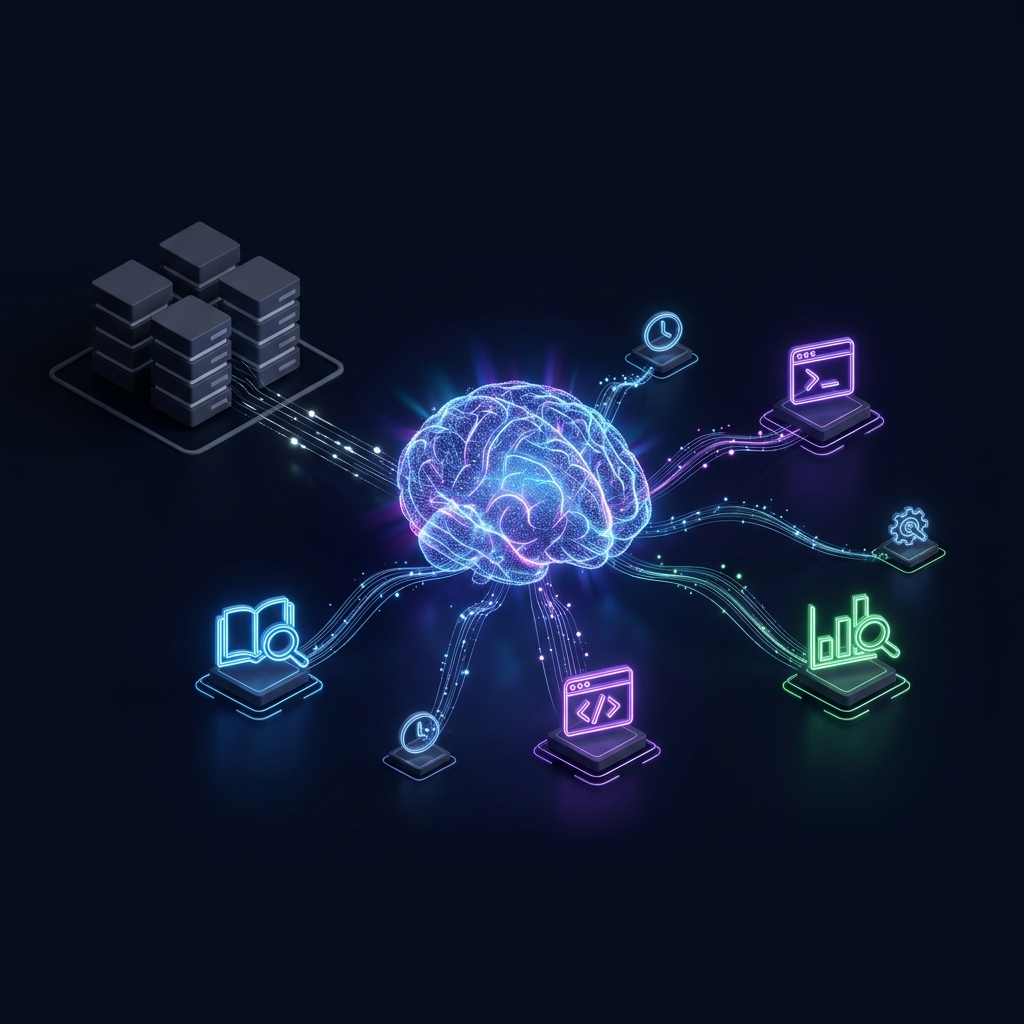
The tech industry is undergoing a structural shift. Static applications are turning into autonomous, reasoning products. Rebuilding core software around LLM decision loops and multi-agent workflows is the new standard of product development.
+74%
YoY Increase in AI Agent Job Roles
85%+
Enterprises Adopting Agentic Workflows
Agentic AI Shift

Product AI Integrations

Applications are evolving from basic databases into active decision systems. Software engineering now heavily revolves around orchestrating cognitive loops, prompt evaluations, and microservices for models.

Enterprise Use Cases

AI agents are already automating full workflows: dev agents fixing code repositories, multi-agent teams curating marketing campaigns, and autonomous customer support groups resolving tickets.

New Interview Standards

Top companies like Microsoft, Google, and Amazon are updating their System Design rounds to evaluate developers on RAG chunking algorithms, vector index efficiency, and agent reliability loops.

Essential Engineering Skill

AI engineering is no longer limited to researchers. Startups and tech hubs are seeking developers who can integrate vector DBs, design agents, and scale cognitive code bases, with a 30%+ salary premium.

Program Overview

What You'll Learn

The AI Engineer Launchpad is an intensive 6-week cohort program that bridges the gap between theoretical AI knowledge and production-grade engineering. Starting with solid ML foundations, progressing through the GenAI stack (LLMs, RAG, embeddings), and culminating in building multi-agent AI systems — every day is a hands-on lab. You'll ship real projects, not just notebooks. This cohort runs every 2 months and is taught by engineers from top product companies who build AI systems at scale.

Who Is This For?

  • Engineering students (3rd/4th year) wanting to break into AI roles
  • Working developers looking to upskill into AI/ML engineering
  • Data analysts transitioning to building AI systems
  • Anyone with Python basics who wants to become an AI Engineer

Prerequisites

  • Basic Python programming (variables, functions, loops)
  • Familiarity with any programming IDE (VS Code recommended)
  • A laptop with 8GB+ RAM and stable internet
  • No prior ML/AI experience needed — we start from foundations
Detailed Syllabus

6-Week Day-by-Day Plan

Every day is a hands-on lab. No slides, no passive lectures. You build from Day 1.

Day 1
Python for ML Engineers
NumPy, Pandas, and Matplotlib deep-dive for ML workflows
Lab: Build an end-to-end data analysis pipeline on a real-world dataset
Day 2
Linear Algebra & Statistics for ML
Vectors, matrices, probability distributions, and hypothesis testing
Lab: Implement PCA from scratch using NumPy to reduce dataset dimensionality
Day 3
Supervised Learning — Regression
Linear regression, polynomial regression, regularization (L1/L2)
Lab: Build a house price prediction model with feature engineering
Day 4
Supervised Learning — Classification
Logistic regression, decision trees, random forests, evaluation metrics
Lab: Build a credit risk classifier with precision/recall optimization
Day 5
Unsupervised Learning & Feature Engineering
K-means, DBSCAN, hierarchical clustering, feature selection techniques
Lab: Customer segmentation pipeline for an e-commerce dataset
Day 6
ML Model Pipeline & Deployment Basics
Scikit-learn pipelines, model serialization, Flask API serving
Project: Deploy your best ML model as a REST API with Docker
Day 7
Neural Networks from Scratch
Perceptrons, activation functions, backpropagation, gradient descent
Lab: Implement a neural network from scratch (no frameworks) to classify MNIST
Day 8
PyTorch Fundamentals
Tensors, autograd, nn.Module, training loops, GPU acceleration
Lab: Rebuild your MNIST classifier in PyTorch with GPU training
Day 9
CNNs for Computer Vision
Convolutional layers, pooling, batch normalization, transfer learning
Lab: Build an image classifier using ResNet transfer learning on custom dataset
Day 10
RNNs, LSTMs & Sequence Models
Sequential data processing, vanishing gradients, bidirectional RNNs
Lab: Build a sentiment analysis model on product reviews using LSTM
Day 11
Transformers Architecture Deep-Dive
Self-attention, multi-head attention, positional encoding, encoder-decoder
Lab: Implement a mini-Transformer from scratch for text classification
Day 12
Model Training at Scale
Hyperparameter tuning, learning rate schedules, mixed precision, Weights & Biases
Project: Train and log a production-quality model with W&B experiment tracking
Day 13
Introduction to Large Language Models
GPT architecture, tokenization, context windows, temperature, top-k/top-p sampling
Lab: Explore OpenAI & open-source LLMs, compare outputs across models
Day 14
Prompt Engineering Mastery
Zero-shot, few-shot, chain-of-thought, system prompts, structured output
Lab: Build a prompt library for 5 real-world use cases with evaluation metrics
Day 15
Embeddings & Vector Databases
Text embeddings, similarity search, ChromaDB, Pinecone, FAISS
Lab: Build a semantic search engine over a documentation corpus using ChromaDB
Day 16
RAG — Retrieval-Augmented Generation
RAG architecture, chunking strategies, retrieval ranking, hybrid search
Lab: Build a RAG chatbot that answers questions from a private knowledge base
Day 17
Advanced RAG Patterns
Multi-query RAG, re-ranking, contextual compression, evaluation (RAGAS)
Lab: Improve RAG chatbot with re-ranking and evaluate with RAGAS framework
Day 18
Fine-Tuning LLMs
LoRA, QLoRA, PEFT, instruction tuning, training data curation
Project: Fine-tune an open-source LLM on a custom domain dataset using QLoRA
Day 19
AI Agents — Architecture & Patterns
Agent loops (Observe → Think → Act), ReAct pattern, tool-calling architecture
Lab: Build a ReAct agent from scratch that uses web search and calculator tools
Day 20
LangChain Deep-Dive
Chains, agents, tools, memory, output parsers, callbacks
Lab: Build a research assistant agent with LangChain that summarizes papers
Day 21
Function Calling & Tool Integration
OpenAI function calling, custom tool definitions, structured outputs, error handling
Lab: Build an agent that queries databases, calls APIs, and generates reports
Day 22
Agent Memory & State Management
Short-term vs long-term memory, conversation buffers, vector memory stores
Lab: Add persistent memory to your agent — it remembers across conversations
Day 23
Multi-Agent Systems with CrewAI
Agent roles, delegation, sequential vs hierarchical task orchestration
Lab: Build a multi-agent content creation crew (researcher, writer, editor)
Day 24
Agent Evaluation & Reliability
Agent benchmarks, failure modes, guardrails, output validation, retry strategies
Project: Add guardrails and evaluation to your multi-agent system
Day 25
AI System Architecture
Microservices for AI, API design for ML models, async processing, queue systems
Lab: Design and implement a scalable AI API service with FastAPI
Day 26
MLOps Fundamentals
ML pipelines, model versioning, CI/CD for ML, model registries, DVC
Lab: Set up an MLOps pipeline with model versioning and automated retraining
Day 27
LLMOps & Observability
LLM monitoring, cost tracking, latency optimization, LangSmith, prompt versioning
Lab: Add observability to your AI agents using LangSmith tracing
Day 28
Vector DB Operations at Scale
Index management, sharding, filtering, metadata strategies, performance tuning
Lab: Build a production RAG system with 100K+ documents and optimize retrieval
Day 29
AI Security & Responsible AI
Prompt injection, jailbreaks, PII detection, bias mitigation, content filtering
Lab: Implement security guardrails — prompt injection detection and PII redaction
Day 30
Deploying AI to Cloud
Docker for AI, cloud deployment (AWS/GCP), serverless inference, cost optimization
Project: Deploy your full AI system to cloud with Docker + CI/CD pipeline
Day 31
Capstone Project Kickoff
Choose your capstone: AI SaaS product, enterprise agent, or research tool
Lab: Project scoping, architecture design, and tech stack selection
Day 32
Capstone — Core Implementation
Build the core AI pipeline and agent orchestration for your capstone
Lab: Implement core features — RAG pipeline, agent logic, tool integrations
Day 33
Capstone — Frontend & Integration
Build the user interface and integrate all system components
Lab: Build a Streamlit/Next.js frontend connected to your AI backend
Day 34
Capstone — Testing & Deployment
End-to-end testing, performance optimization, production deployment
Lab: Deploy your capstone project to production with monitoring
Day 35
AI Engineer Interview Prep
Common AI engineering interview patterns, system design for AI, take-home assignments
Mock: Solve 3 real AI engineering interview problems with live feedback
Day 36
Demo Day & Graduation
Present your capstone, receive certification, and get career guidance
Live: Capstone presentations, peer review, certification ceremony, and networking
Outcomes

What You'll Walk Away With

Skills, projects, and credentials that make you hireable as an AI Engineer.

🧠
ML & Deep Learning Mastery
Build and deploy ML models from scratch — regression, classification, neural networks, and transformers
🤖
GenAI Stack Proficiency
Master LLMs, prompt engineering, embeddings, RAG, and fine-tuning for production use cases
🔗
Agentic AI Builder
Design and build multi-agent AI systems that reason, use tools, and collaborate autonomously
🚀
Production AI Deployment
Ship AI systems with MLOps, LLMOps, Docker, cloud deployment, and observability
🛡️
AI Security & Reliability
Implement guardrails, prompt injection protection, PII redaction, and bias mitigation
💼
Career-Ready Portfolio
6+ production projects and a capstone that serves as your AI engineering portfolio piece
Real-World Projects

Case Studies You'll Build

Not toy examples. These are production-grade AI systems you'll build and deploy.

Enterprise Knowledge Assistant
Build a RAG-powered AI assistant that answers questions from 100K+ company documents with source citations, re-ranking, and contextual compression.
LangChainChromaDBOpenAIFastAPIRAGAS
Multi-Agent Research Crew
Create an autonomous team of AI agents — a researcher that finds papers, an analyst that extracts insights, and a writer that produces executive summaries.
CrewAILangChainTavily SearchGPT-4Streamlit
AI-Powered Code Review System
Build an intelligent code review agent that analyzes pull requests, detects bugs, suggests improvements, and explains complex code changes.
OpenAI Function CallingGitHub APIAST ParsingFastAPI
Industry Aligned

Designed with Industry Partners

Every module is co-designed with engineering leaders from top product companies. The curriculum mirrors what AI teams actually build — not academic theory.

Curriculum Principles

  • Built around production AI system patterns, not textbook exercises
  • Tools and frameworks used by AI teams at FAANG companies
  • Code reviews and architecture feedback from industry mentors
  • Interview-prep integrated into every project milestone

Tech Stack You'll Master

  • Python · PyTorch · Scikit-learn · NumPy · Pandas
  • OpenAI API · LangChain · CrewAI · LlamaIndex
  • ChromaDB · Pinecone · FAISS · Vector Databases
  • FastAPI · Docker · AWS/GCP · W&B · LangSmith
Elite Mentorship

Learn from Instructors at Top Product Companies

Our live lectures, code reviews, and system design masterclasses are led by Senior AI Engineers, Tech Leads, and AI Architects currently building at:

GoogleGooglePayPalPayPalAmazonAmazonLinkedInLinkedInJP MorganJP MorganWalmartWalmartAdobeAdobeMicrosoftMicrosoftJusPayJusPayMorgan StanleyMorgan StanleyRazorpayRazorpayPhilipsPhilipsNielsenNielsenMotorqMotorqPublicis SapientPublicis SapientAMDAMDServiceNowServiceNowGoogleGooglePayPalPayPalAmazonAmazonLinkedInLinkedInJP MorganJP MorganWalmartWalmartAdobeAdobeMicrosoftMicrosoftJusPayJusPayMorgan StanleyMorgan StanleyRazorpayRazorpayPhilipsPhilipsNielsenNielsenMotorqMotorqPublicis SapientPublicis SapientAMDAMDServiceNowServiceNow

Learn from Active Builders

Get insights into production-level code, system reliability, and real AI challenges that you only encounter at scale in Tier-1 companies.

System Architecture Reviews

Mentors review your weekly capstones, giving you direct feedback on modular programming, latency optimizations, and database scaling.

Referrals & Networking

Unlock internal referrals for AI and software engineering roles. Build professional relationships with engineers inside top global tech hubs.

Certification

Certification & Career Opportunity

🎓
AI Engineer Certification
Upon successful completion of the 6-week program and capstone project, you will receive an AlgoTutor AI Engineer Certification — a verifiable digital credential that validates your practical AI engineering skills. Add it to your LinkedIn, resume, and GitHub.
🚀
AI Engineer Intern Opportunity
The top performer in each cohort (based on capstone project quality, participation, and peer reviews) will receive an exclusive opportunity to work as an AI Engineer Intern with AlgoTutor or our industry partners. This is a paid internship with potential for full-time conversion.
Frequently Asked Questions

Got Questions? We Have Answers

Everything you need to know about the AI Engineer Launchpad cohort program.

Who is this cohort program for?

This cohort is designed for engineering students, working developers looking to transition to AI, data scientists wanting to build software agents, and tech builders with Python basics who want to learn production AI engineering.

What is the duration and schedule?

The program runs for 6 weeks, featuring live interactive classes on weekends and weekday evenings (IST) to accommodate both students and working professionals. All live sessions are recorded and uploaded with code repositories.

How does the AI Engineer Internship opportunity work?

The top performer in each cohort (determined by capstone project quality, peer code reviews, and active participation) will be awarded a paid AI Engineer Internship with AlgoTutor or our startup partners.

Will I receive a certificate?

Yes. Upon completion of the curriculum and capstone projects, you will receive a verifiable smart certificate of completion that you can share on LinkedIn, resume, and GitHub portfolios.

Do I have lifetime access to the resources?

Absolutely. You get lifetime access to the curriculum updates, recorded lectures, repository templates, and membership in the exclusive developer community Slack/Discord channels.

Is there a refund policy?

Yes. We offer a no-questions-asked 100% refund policy if requested within 3 days of the cohort kickoff. Simply email our support team.

AI Engineer Launchpad
6-Week Intensive · Starts Sep 1, 2026
14,99929,999
  • 100% Hands-On — No Slides, Only Code
  • Build 6+ Production AI Projects
  • Live Sessions with Industry Engineers
  • Certification on Completion
  • Top Performer → AI Engineer Internship
  • Lifetime Community Access
Pay & Secure Your Seat
Secure payment powered by Razorpay · Instant confirmation